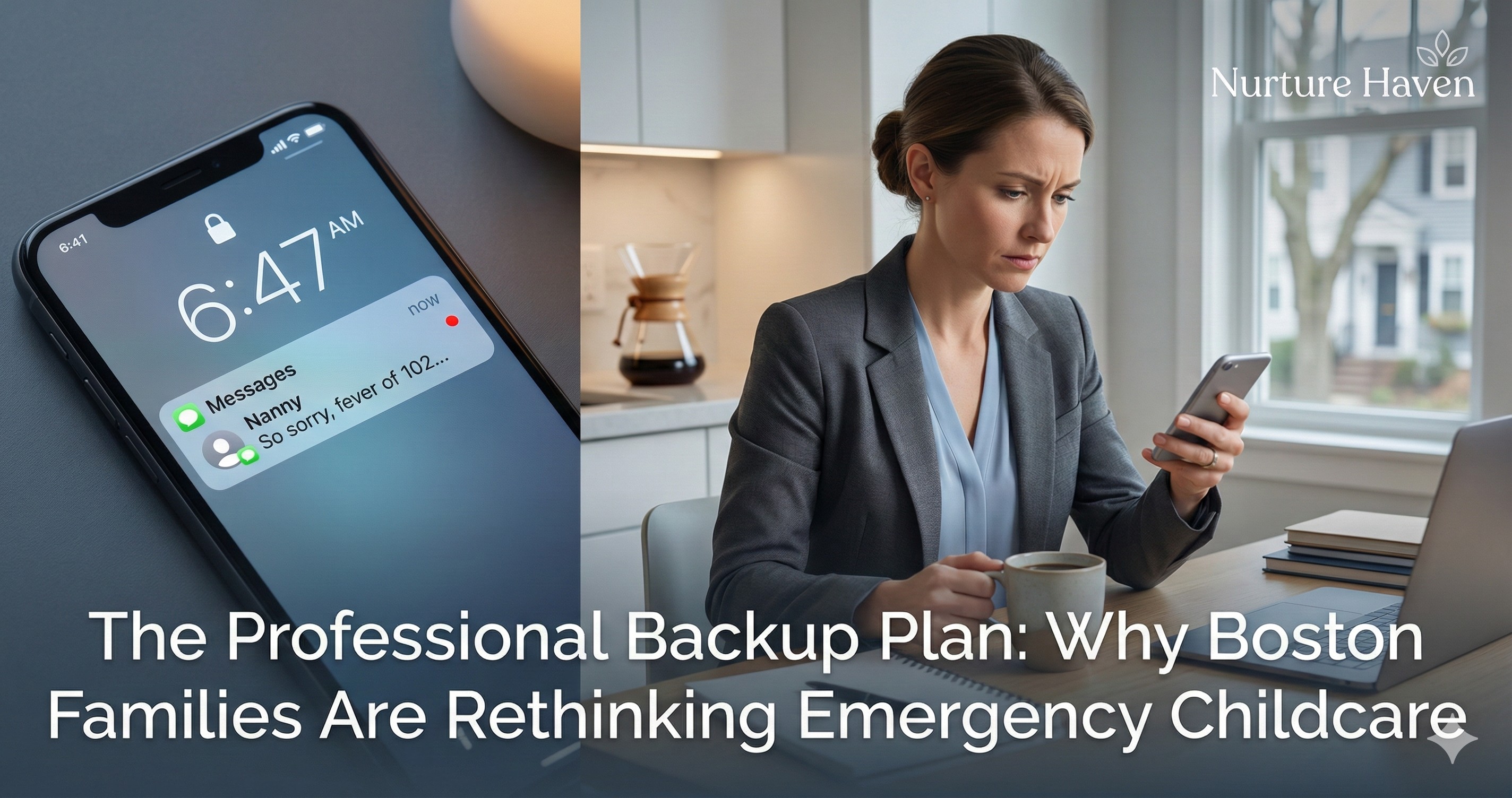

There's a moment every high-performing professional knows well.
You're in the middle of a critical negotiation, a board presentation, or a deal that's been months in the making—and your phone buzzes with an urgent text from home. The nanny is asking a question that shouldn't need to be asked. Or worse, you realize mid-meeting that you never confirmed pickup logistics for your daughter's orthodontist appointment.
For executives, entrepreneurs, and high-net-worth families in Boston and Metrowest, the most valuable asset isn't just time. It's cognitive bandwidth—the mental space to focus fully on what matters without the constant low-grade hum of household logistics pulling at your attention.
And yet, most families approach the nanny search the same way they'd hire anyone else: resumes, references, a few interviews, hope for the best.
That approach works fine for average childcare needs. But high-performance households require a fundamentally different kind of search.
Most nanny searches focus on experience and personality. Can she handle two kids under five? Does she seem warm? Will the children like her?
These questions matter. But they miss what actually determines success in a high-acuity household: executive function.
Executive function is the ability to anticipate problems before they become crises. It's noticing that the pediatrician appointment conflicts with the school fundraiser pickup—and solving it before anyone has to ask. It's recognizing that the seven-year-old has been unusually quiet for three days and flagging it to the parents before it escalates into a behavioral issue or health concern.
The RN Perspective: In clinical settings, we call this "anticipatory assessment"—the skill of reading a situation, identifying what's likely to go wrong, and intervening early. It's the difference between a nurse who waits for the alarm to sound and one who notices the subtle vital sign shift twenty minutes earlier.
When we vet candidates for executive placements, we're not just checking boxes on experience. We're assessing judgment, pattern recognition, and the ability to manage complexity without constant direction.
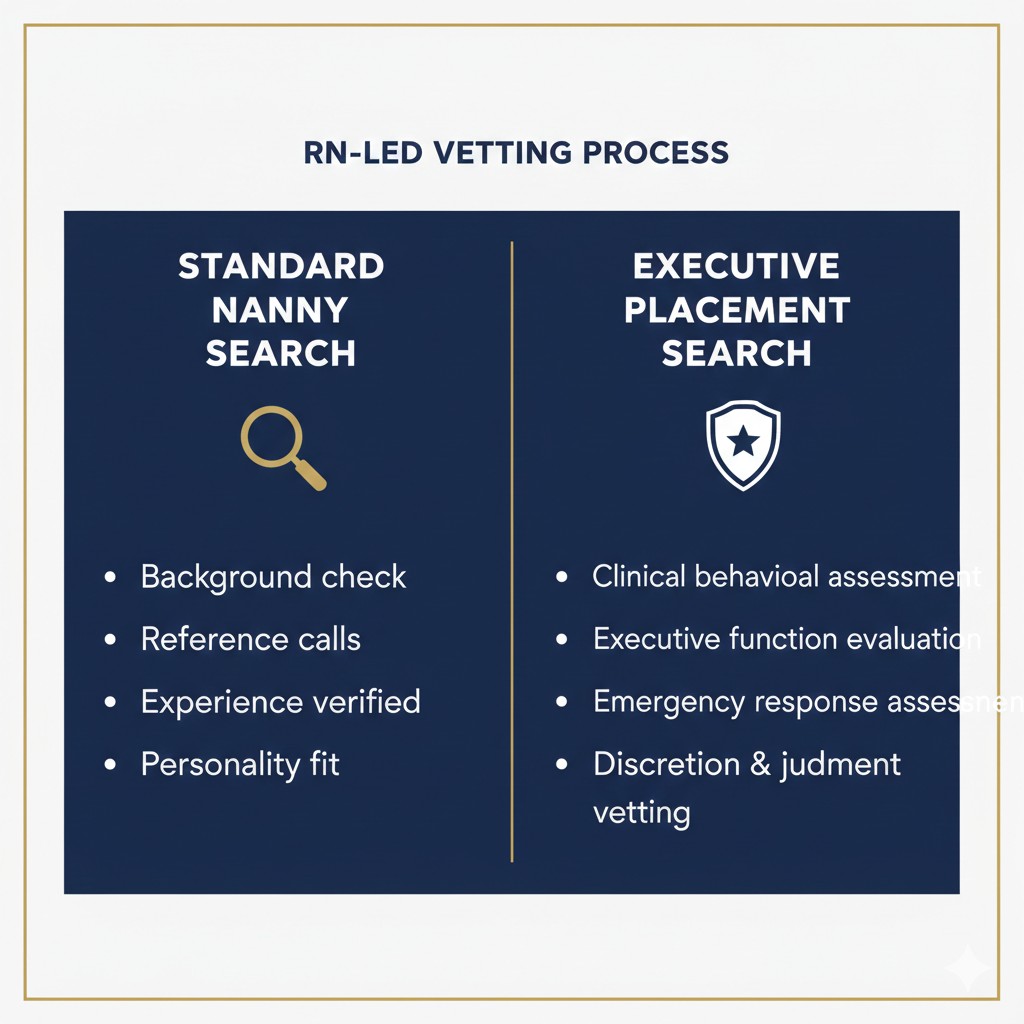
Standard nanny agencies run background checks and verify references. That's the floor, not the ceiling.
As an RN-led agency, we apply a clinical lens to every candidate we present for high-stakes placements. Our assessment process focuses on three areas that don't show up on a resume:
How does a candidate respond under pressure? We evaluate not just whether someone has CPR certification, but whether they can remain calm and decisive when a child is choking, when a fall looks serious, when something feels "off" but isn't obvious. This isn't hypothetical—it's the skill that matters most when parents are unavailable and a real situation unfolds.
Can a caregiver accurately follow complex instructions? Interpret medication dosing? Recognize when a child's symptoms warrant a call versus a wait-and-see approach? For families managing allergies, chronic conditions, or simply wanting confidence that their caregiver can handle the unexpected, this matters enormously.
Does a candidate understand the ethics of working within a high-profile environment? Can she navigate the complexity of being "part of the family" while maintaining appropriate discretion? This is where many otherwise excellent caregivers struggle—and where our vetting process goes deepest.

For families in the public eye—professional athletes, C-suite executives, entrepreneurs whose names appear in the news—privacy isn't a preference. It's a security requirement.
The person you invite into your home has access to your daily schedule, your children's routines, your private conversations. In the wrong hands, that information becomes liability.
What We Look For: Our vetting process includes social media audits and behavioral interviews designed to assess a candidate's instinctive understanding of privacy. We're looking for caregivers who grasp that "being part of the family" doesn't mean sharing the family's life on Instagram. Who understand that casual conversations with other nannies at the playground require discretion. Who treat your home as the private sanctuary it should be.
The RN Standard: I spent years handling sensitive patient information under strict HIPAA guidelines—where a single privacy violation could end a career. That same clinical standard of confidentiality is built into how we vet and train caregivers for high-profile placements.
Here's something most families don't realize: the nanny search process itself often predicts whether a placement will succeed long-term.
Rushed searches lead to compromise hires. Compromise hires lead to turnover. Turnover means starting over—more interviews, more transitions for your children, more cognitive bandwidth drained from your professional life.
We approach executive placements as a search partnership, not a transaction. Our role is to understand the specific demands of your household, identify candidates who meet the clinical and professional standards required, and present only those who genuinely fit.
For our event care and backup services through the Sitter Club, we employ caregivers directly on a W2 basis—handling insurance, taxes, and accountability. For long-term placements, we act as your elite search partner, ensuring the person who becomes part of your household has earned that position through rigorous vetting.
Whether you're managing a demanding career in downtown Boston or running a household in Wellesley, Weston, or Newton, your childcare shouldn't be another source of mental load. It should be a source of peace.
The right household partner doesn't just watch your children. She manages the ecosystem of your home so you can focus on your work, your family time, and your legacy—without the constant hum of logistics pulling at your attention.

That's not a luxury. For high-performance families, it's a necessity.
Schedule a confidential consultation to discuss your family's needs and learn how RN-led executive search can transform your home into a high-functioning, low-friction environment.